Skip to content

Engaging Disability, Empowering History: Ethics and Politics of Disability History

Samuel E. Kelly Distinguished Faculty Lecture

Engaging Disability, Empowering History:
Ethics and Politics of Disability History

Featuring Dr. Joanne Woiak

Associate Teaching Professor
Disability Studies Program

Established in 2005 and named in honor of the UW’s first vice president for the Office of Minority Affairs, the annual Samuel E. Kelly Distinguished Faculty Lecture is dedicated to acknowledging the work of faculty whose nationally-recognized research focuses on diversity and social justice.

This year marks the 50th anniversary of Section 504, the first disability civil rights law enacted in the United States. In this lecture, Dr. Woiak explored questions about how the histories of disabled people and the concept of disability are remembered and forgotten. When society, academia, and historical records marginalize and erase disability, whose stories are left untold? And what are the consequences for people with disabilities today? Disability historians examine the archives through the critical lenses of disability studies and intersectionality, producing and making accessible new knowledge about lived experiences and cultural beliefs around disability. Drawing from the example of studies of the Black Panther Party’s role in the fight to implement Section 504, the lecture addressed the impacts of engaged and empowering directions for historical inquiry into disability activism, politics, and community.

Disability historians examine the archives through the critical lenses of disability studies and intersectionality, producing and making accessible new knowledge about lived experiences and cultural beliefs around disability. Drawing from the example of studies of the Black Panther Party’s role in the fight to implement Section 504, the lecture addressed the impacts of engaged and empowering directions for historical inquiry into disability activism, politics, and community.


Sacred Breath: Indigenous Writing and Storytelling Series

November 16, 2023 at 5-8pm atwəłəbʔaltxʷ Intellectual House

Doors open at 5:30 PM with light refreshments

Event is FREE but

The Department of American Indian Studies at the hosts an annual literary and storytelling series.Sacred Breathfeatures Indigenous writers and storytellers sharing their craft at the beautiful wǝɫǝbʔaltxʷ Intellectual House on the UW Seattle campus.Storytelling offers a spiritual connection, a sharing of sacred breath. Literature, similarly, preserves human experience and ideals. Both forms are durable and transmit power that teaches us how to live. Both storytelling and reading aloud can impact audiences through the power of presence, allowing for the experience of the transfer of sacred breath as audiences are immersed in the experience of being inside stories and works of literature.

From Artistic Joy to Collective Wellness with Marc Bamuthi Joseph

By Meany Center for the Performing Arts

At Meany Center, we believe that art-focused, youth-centered, mental health today is a key ingredient in an equitable and inspired social future. Our 2023–24 season engagement withbegins our journey of imagining Meany as a cultural hub that facilitates accessible pathways from artistic joy to collective wellness.

In this coming year, our engagement team will be gathering various communities of practice together with Marc — who is engaged for five separate virtual and in-person residency visits — to imagine ways to normalize arts spaces as hubs for mental and emotional wellness for young people of all kinds.

We began our partnership with Marc Bamuthi Joseph in 2021, withprogram, through which Meany Center staff identified the mental health of our student population at UW to be a top priority and a place where we felt we were well positioned to make a meaningful impact. This season we will explore the various ways that Meany’s programs can support the wellness of young people in our region, together with our partners who are committed to these values in their work with students on the UW campus and with youth in our surrounding communities.

Look for opportunities to engage with us around these ideas, including Marc’sUW Public Lectureat Town Hall on March 5, 2024. Marc’s residency with Meany will also include the premiere of his newest piece,, at Meany Center on Saturday, April 6, 2024.

To learn more about this initiative, please contact our engagement manager, Kristen Kosmas:kkosmas@uw.edu.

UW PANDEMIC PROJECT | RADICAL LISTENING SESSION (Nov 7th)


When:November 7th, 2023

Where:Virtual & Walker Ames (Kane Hall)

Time:6:30 pm to 8 pm

Event Description:The Pandemics – COVID 19 and the worldwide racial reckoning – forever changed how we work, live, go to school, and interact as a community. Come listen to recorded dialogues about the pandemics, and engage in dialogue with your UW community. Together we will remember and honor our lived pandemics experiences.

Sharon Stein, “The University and Its Responsibility for Repair: Confronting Colonial Foundations and Enabling Different Futures” | A Worlds of Difference lecture (Nov 7th)

For the past 500 years, higher education has been entangled in the reproduction of social and ecological violence around the globe. This presentation asks how universities, and those of us who work and study within them, might meaningfully reckon with and enact repair for our complicity in historical and ongoing coloniality and unsustainability. It approaches reparations as a potentially regenerative process of enacting material redistribution and restitution, (re)building relationships grounded in respect and reciprocity, and repurposing our institutions to be more relevant and responsible in the context of the current polycrisis. The talk will also review several resources for navigating the complexities of confronting the colonial foundations of higher education and enabling different futures.

Sharon Stein(Educational Studies, University of British Columbia) is the author ofUnsettling the University: Confronting the Colonial Foundations of US Higher Education(Johns Hopkins, 2022), founder of the Critical Internationalization Studies Network, and a co-founder of the Gesturing Towards Decolonial Futures (GTDF) Collective.

WHEN Tuesday, Nov 7, 2023, 4:30–6p.m.
EVENT INTERVAL Single day event
CAMPUS LOCATION
CAMPUS ROOM 120
ACCESSIBILITY CONTACT Accommodation requests related to a disability or health condition should be made 10 days in advance to the Simpson Center, 206.543.3920,schadmin@uw.edu.
EVENT TYPES Lectures/Seminars
EVENT SPONSORS Simpson Center for the Humanities,humanities@uw.edu, 206.543.3920
Co-sponsored by the Office of Global Affairs in partnership with the UW Law Sustainable International Development Graduate Program, the Comparative History of Ideas Department, and Latin American and Caribbean Studies.


UW Launches Faculty Diversity Initiative

Diversity, in the words of University Diversity Officer Rickey Hall, is everybody’s everyday work. To further accelerate this ongoing work, Provost Mark Richards has launched a Faculty Diversity Initiative to examine the policies, practices, and climate that impact our ability to attract and retain faculty who advance our diversity goals.

The initiative, consistent with Regent Policy 33, includes redirecting University resources to bridge funding that will help departments recruit faculty who will advance the University’s diversity goals. In addition, a subgroup of the Race & Equity Steering Committee will examine best practices across the nation – and within our University – and make recommendations on benchmarks and accountability for recruitment, hiring, and retention in alignment with the UW’s Diversity Blueprint.

Read more about the initiative which builds on the substantial contributions of the Office for Faculty Advancement, the Office of Minority Affairs & Diversity, the Office of Academic Personnel, and the Office of Research, among others. Further and more critically, this work builds upon the efforts of generations of BIPOC faculty who have voluntarily recruited and mentored additional faculty that advance diversity.

FORiSCHOOL SCHOLAR, ART HOLDS KEY TO NATIVE KNOWLEDGE

UW TODAY

By Jim DavisThursday, October 8, 2020

probably was always destined to study art. On her father’s side, she is Zuni Pueblo, a tribe in the Southwest U.S. with a rich aesthetic tradition and love of adornment.

“If there’s something that we could paint on, we’re gonna paint it,” said the Information School assistant professor. “We’re gonna make it beautiful.”

On her mother’s side, Belarde-Lewis is Takdeintaan Clan from the Tlingit tribe, one of the Native groups in Alaska who cherish stories of the trickster Raven figure: “There’s this phrase that Ravens like shiny things. So, either way …”

There’s a less happy reason why Belarde-Lewis studies Native American art, a reason that dates back nearly a half a millennium.

“I’m so invested in Native art because it’s something that has survived 500 years of intense colonization,” Belarde-Lewis said. “It represents activities and ceremonies that were directly outlawed and banned and targeted for eradication through various federal policies.”

For many years, the only safe way for American Indians to express their culture was through artwork, commodities often sold to tourists, she said. Belarde-Lewis has studied Native art, first in her work at museums and now in her academic career at the UW.

To further her study, Belarde-Lewis was recently named the inaugural recipient of the Joseph and Jill McKinstry Endowed Faculty Fellowship in Native North American Indigenous Knowledge, the first endowment for the iSchool in this area of study.

The award comes with funding that Belarde-Lewis can use with a great deal of discretion to apply for federal grants, bring speakers to the campus and the community, and aid in other ways with her research.

Associate Professor Emerita, director of the iSchool’s Native North American Indigenous Knowledge research initiative, is ecstatic for her former student and current iSchool colleague. “I’m doing my happy dance,” Metoyer said. “I absolutely could not be more pleased.”

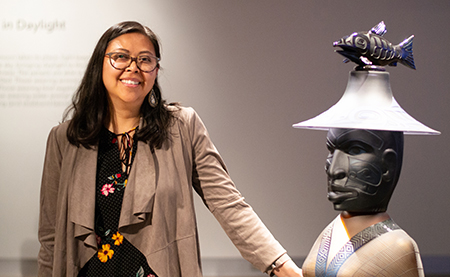
Miranda Belarde-Lewis curated the "Raven and the Box of Daylight" exhibit of works by glass artist Preston Singletary, displayed at the Tacoma Museum of Glass in late 2019.
Miranda Belarde-Lewis curated the “Raven and the Box of Daylight” exhibit of works by glass artist Preston Singletary, displayed at the Tacoma Museum of Glass in late 2019.

The fellowship is a bright spot, but another achievement for Belarde-Lewis is on hold at least for now. Belarde-Lewiscalled “Preston Singletary: Raven and the Box of Daylight” created by glass artist Preston Singletary. It features the Tlingit story of how Raven transformed the world.

The exhibit was headed to the Smithsonian’s National Museum of the American Indian this fall, but the opening has been pushed back due to COVID-19 until at least spring 2021.

Metoyer takes in pride in Belarde-Lewis, recalling fondly watching her former student demonstrate her teaching method to a class when applying for a full-time iSchool position.

“She was able explain not only the process of creating the pottery and all of the layers of symbolism that you see there, but also talk about the information that’s part of the creation process from the start to the finish,” Metoyer said.

The general public often is ignorant of Indigenous issues, Belarde-Lewis said. One of the ways to reclaim the narrative for Native Americans is through art.

“Native art is information,” Belarde-Lewis said. “It’s knowledge, and how that can be expressed on our own terms is just incredibly inspiring and empowering.”

Pictured at top: Miranda Belarde-Lewis gazes at a glass sculpture by artist Preston Singletary at the Tacoma Museum of Glass during a 2019 exhibit. (Photos by Doug Parry)

UW Libraries Immigration Resources

Post from UW Libraries website:

The UWLibraries recognizes that many students and researchers on our campus have been affected by ongoing and recent immigration and travel bans. We are a university and library system that is proud towholeheartedly welcomeand supportundocumented students of all ethnicities and nationalities.Undocumented students are eligible for state tuition, state benefits, and resources. Below are resources that may be of use to those who are facing legal difficulties with citizenship and movement in and outof the United States.If you are not sure who to contact, a librarian can point you towards further resources. Communication with a UW Librarian isalways confidential and we never release any personal information about you to third parties. , as well as community resources below, hold free legal advice and sessions to take advantage of.

Race & Equity Initiative Anti-Racism Resources

We present this list for all who would like to gain a deeper understanding of historical and present-day manifestations of racism in the United States. This list of guides and resources is just a small sample of the abundance of resources available online. In the coming days and weeks, we will continue to add resources. We hope these resources will serve to both affirm and support you if you belong to a group that has been impacted by racism and a place to deepen your knowledge of the issues as you take action against racism.

Articles:


Websites:


Resources for parents:


Reading lists:


Videos:


Podcasts:


Books and Publications:

Adams, M. (Ed.). (2000). Readings for diversity and social justice. Psychology Press.

Feagin, J. (2013). Systemic racism: A theory of oppression. Routledge.

Linder, C., Harris, J. C., Allen, E. L., & Hubain, B. (2015). Building inclusive pedagogy: Recommendations from a national study of students of color in higher education and student affairs graduate programs. Equity & Excellence in Education, 48, 178-194.doi:10.1080/10665684.2014.959270

Johnson, A. G. (2001). Power, privilege, and difference. Mountain View, CA: Mayfield.

Lau, M. Y., & Williams, C. D. (2010). Microaggressionsresearch: Methodological review and recommendations. In: D. W. Sue (Ed.). Microaggressions and marginality: Manifestation, dynamics and impact (pp. 313–336). New York, NY: Wiley

Nadal, K. L., Wong, Y., Griffin, K. E., Davidoff, K., & Sriken, J. (2014). The adverse impact of racial microaggressionson college students’ self-esteem. Journal of College Student Development, 55, 461-474. doi:10.1353/csd.2014.0051

Ross, L. (2016). Blackballed: The Black and White Politics of Race on America’s Campuses. Macmillan.

Sue, D. W. (2003). Overcoming our racism: The journey to liberation. John Wiley & Sons.


Black Lives Matter Syllabus 2016:

Marc Lamont Hill,Nobody: Casualties of America’s War on the Vulnerable, from Ferguson to Flint and Beyond(Simon & Schuster, 2016)

Michelle Alexander,The New Jim Crow: Mass Incarceration in the Age of Colorblindness(New Press, 2012)

Angela Davis,Are Prisons Obsolete?(7 Stories Press, 2003)

African American Policy Forum,Say Her Name: Resisting Police Brutality Against Black Women(African American Policy Forum Report, 2015)

Movement for Black Lives,A Vision for Black Lives: Policy Demands for Black Power, Freedom, and Justice(Movement for Black Lives Policy Platform, 2016)

Assorted essays by Cornel West, Alicia Garza, Audre Lorde, Kimberle Williams Crenshaw, Shaun King, and more available at


If you have any questions comments or additions to this list, please contact Leilani Lewis, lanil (at) uw.edu